Wednesday, February 5, 2014

Figuring out what's next

About a week ago I had my 27th birthday. In some respects turning 27 wasn't all that different from turning 25 or 26 - each time I felt the same before and after.  But this time the day itself fell when I was on a business trip in Erbil Iraq, and I was arranging a workshop for 100 NGOs and Technologists to train them on how to use technology to fight corruption.

I've come a ways in the past year. I finally, finally snagged myself a job at a great organization, the U.S. Institute of Peace. I have a girlfriend whom I love deeply. I'm a little less in debt, have a little more pocket change. But a lot is the same from the past year, too. I find myself worrying about the future, and trying to figure out what the "next step" is. 

I'm beginning to realize this will probably never change. A moving goal post is a good thing for a person, and I doubt (and don't desire) that I'm going to plateau into happy security any time soon.

In this case, now that I've found my way to a great organization, I find myself wanting to change my role inside it. I'm itching to do more than the program assistant work - for all the projects I've organized, I just don't have a head for event logistics, and never truly will. What I really love is doing something creative. I think I'd like to try my hand at developing a serious game for peacebuilding - one that doesn't suck, as so many have before. I've been plugging away and making another game since Shaped (always very slow paced - many steps sideways and three steps back), but if push came to shove and it became my only task... well, I'd rather have that challenge and fail than not have that challenge.

The thing is I realize that this next step, when it comes, is not the end all be all either. It's just the next iteration in a long, complex process. Years from now I'll probably be doing something else very different. On my 40th birthday I'll probably be someplace I can't predict.


Saturday, January 19, 2013

How to bring Gmail (and other Chrome apps/bookmarks) to your Windows 8 Start Menu.


As an early adopter of Windows 8, I've been a little disappointed with the utility of the operating system. One of my major frustrations is the inability pin a website to the Start Menu. (Well, strictly speaking, that isn't true - there's a technique to do it with Internet Explorer. But I'm a Chrome user, and irritated that Microsoft is plainly funneling me towards it's browser.) If you're like me, you're also a little disheartened that Google wont be creating apps for Windows 8. Luckily, though, after an afternoon of tooling around I've come up with a simple workaround that brings not only Gmail, but the full range of Chrome apps and bookmarks, straight to your Windows 8 Start menu.

Here's how!

1. Open Chrome and go to the "New Tab" menu.


2. Right Click "Gmail" (or whatever other bookmark you drag onto the New Tab screen) and Select "create shortcuts".

At this point, you can also chose to "open full screen" if you want a Metro Style (ish) app. It will still load on your Desktop.

3. Create a Desktop Shortcut.


4. On your Desktop, right-click your new icon and select "Pin To Start".


You can't pin ordinary URL shortcuts to the Start Menu, but the system views this one as a special launcher of Chrome.

5. Done! On your Start Menu you will find a unique version of your Chrome app.

You can now delete the shortcut from your desktop. It will still run!
It's an imperfect system. Even if you launch these shortcuts in "full screen mode", they will all end up on the Desktop app system, meaning you'll have to do some finicky closing of windows to jump between your apps. And, sadly, this system doesn't work for Mozilla Firefox users! But it isn't a bad way to bring Gmail to your desktop in way that doesn't involve Internet Explorer.

Tuesday, December 25, 2012

Musing on Procedural Generation


Wow - this blog is still here. 

It's been a while since the last post, and it's going to be of an entirely different character. I'm writing this blog mainly as an exercise to flesh out some thoughts I've had tonight about coding. Suffice it to say that in the time between Cairo and now, I've founded an indie game studio (Send More People) and started to get into the language C#.

The Gist of It

Space sometimes poses a challenge for game designers. Space is big - our own galaxy has something close to 100 billion stars in it, and many of these stars have orbiting planets. Generating billions of systems can be tricky for reasons of scale - storing the data, and, from a design standpoint, ensuring that each system is built properly.

Spore supplied players with a vast procedurally generated Galaxy
Minor segue: games like Escape Velocity had a few hundred star systems and hand-crafted each one. Usually there were only a handful of planets in each given scene, and their qualities were pre-determined. Compare that to a games like Sins of a Solar Empire - where each game is set in a procedurally generated star system - and the scripted feel is exchanged for variable gameplay. And it occurs to me now, Spore did a great job at generating a galaxy... although it didn't give you much to do in it.

Anyway, I'm thinking that it would be fun to procedurally generate a universe for a player to explore. Here's how I might organize the variables in a such a system, and the variables they might produce. Each of these variables should be derived with the others in mind; for example, planets closer to the star  would likely be warmer than those further, etc. The relationships would be complex, though - surface temperature would also be influenced by, axis rotation, atmospheric content, day length, etc.
  • Stars
    • Number of (Integer, likely 1-2)
    • Type (name)
      • Brightness (Float, Scale 1-10)
      • Size (Float, Diameter km)
      • Mass (Float, Whatever the Unit of measurement is for stars...)
  • Planetary Bodies
    • Number of (Integer, Probably between 0-15?)
    • Size (Float, km)
    • Atmospheric content (Array, Chemicals and % of Atmosphere)
    • Mass (Float, kg?)
      • Gravity (Float, Unit is "G" for earth gravity.)
    • Surface Composition 
      • Chemical (Array, Elements and %)
      • Liquid on the surface (Boolean)
        • Size of Bodies of water (Integer, percentage of surface area)
    • Life 
      • Exists? (Boolean)
      • How Many forms (Integer)
      • Intelligent (Boolean)
        • Hostile (Yes/No/Neutral)
        • Technological Development (Array, Stone-age to space god)
      • (Many, Many other variables possible)
    • Moons Orbiting
      • Same variables for planets
    • Orbit period
    • Revolution period
    • Axis Rotation
  • Asteroid Belts
    • Number of asteroids (Integer)
    • Size of asteroids
    • Speed 
    • Composition

Look at your watch, dude.

Its nearing 1am and it's Christmas day, so I'm calling it a night. But in closing, it occurs to me that there are multiple levels of complexity that are possible for procedurally generating a star system, and each level of complexity seems to exponentially increase the difficulty in creating system. Likely I'll want to hit some middle ground between just randomly generating a number of planets and moons, and meticulously generating individual characteristics of said bodies.

Something to consider. Over and out.

Sunday, August 22, 2010

Prepare for Takeoff

As predicted, my determination to blog every week or so collapsed soon after I landed here in Cairo. Now I'm faced with the task of representing all of the past few months in a few brief paragraphs. It's a daunting challenge.

The funny thing that I'm conscious of just how little of Egypt I've actually seen. It's is not a large country compared to the United States, but out of all the places I potentially could have gone - Mount Sinai, Dahab, Siwa, Luxor, and many a good beach besides - I've only left town to see Alexandria.

At least I can report that the Alexandria was fantastic. I went for a three day excursion with a few of the boys and girls from my Arabic class. Good times were had by all. Our first stop was Mamoura, a gated beach community about 17 km from Alexandria ("Askanderia" in the vernacular). We were told that we had a house reserved for us right next to the water - this building would be our base of operations for the next few days. Unfortunately our "reservation" was actually just the say so of a local, who actually was in no position to guarantee that the apartment would be free. As it turned out we were competing for the place along with all of Egypt, since the Alexandria beach was a vacation destination. Somehow we were able to finagle an apartment in Mamoura for the same price - after, of course, assuring our host that all of us were married.

It took a long time to figure our sleeping situation out - the better part of the afternoon actually - so we decided just to spend the rest of our time at the beach. It was crowded. The spot we bought might have been no more than 10 meters or so from the water, but we couldn't see it but for the throng of Egyptians, umbrellas, and tables between ourselves and the ocean. Once we got to it though, the water was divine; pleasantly warm and refreshing. Big breakers crashed over our heads. For a person who grew up with the chill and relatively tame water of inner Cape Cod, it was a wonderful experience.

Unfortunately, we hadn't quite done all of our homework about Mamoura. My guidebook cautioned women to "cover up" and wear shorts and a tee shirt over their swim outfit. That advice could even have been taken further - my two friends from Germany and Austria wrapped themselves in a sarong and still had were hassled by Egyptian men. One fellow came up to Katrin in the water and held out hands to shake. Embarrassed, she complied, and then had to forcefully detach herself when the man wouldn't let go until I swam up and signaled for him to please stop touching my "wife". Our friend Tamara fared worse - she was knocked over by a breaker and a man "helped her up," grabbing her breast in the process. Judging from the complete lack of uncovered women at this beach, we should have perhaps been more conscious of local customs and mores, and come better prepared with longer clothes and spare tee-shirts for our girls. Egyptians are a wonderfully kind people, but for some reason - maybe the lack of sex in their own culture before marriage, or their perception of western women as promiscuous - some of these men felt comfortable in grabbing and touching our friends in a way that they would have never done to one of their own.

Luckily the rest of the beach day was fantastic. A group of locals challenged us to a game of beach football (soccer) and we had a wonderful time. I flatter myself that I was the principle striker on our team - three goals scored! Sadly I did not live up to form as a goalie. Afterwards many people came up to us and asked for their pictures to be taken with us. One even handed his baby over to my "wife" Dania and me... somewhere on an Egyptian camera somewhere there is an image of a tall, sandy and sunburned American with a short brownhaired girl, holding what appears to be our little brown love child. What a funny world.

As the sun was setting I spoke to an Egyptian who came up to me and started speaking in slow, but clear English. We agreed that Askanderia was a beautiful place and the sunset was fantastic - but then he said something else that struck me. "Egyptians love America, love France, and Europe," he said. "But the rest of the world, they don't like us." By us, I understood that he wasn't just talking about Egyptians but also Arabs and Muslims. I tried to answer as simply and as honestly as I could. I said that people were afraid of the Middle East because they didn't know much about it, and what they did know they misunderstood. But I assured him that in my group at least, there were five westerners (and one Korean!) who appreciated his country very much. He didn't really seem convinced.

Shew. I barely scratched the Alexandria trip but I've already run out of space (by which I mean drive) to continue on in this sitting. Makes me wish I had been keeping up with this blog all along - it would have been much easier to keep up with events.

Here's hoping I can squeeze more in. If the next article is about some political issue... well, my biographers are going to need another source for the Egypt chapter! Ta.

Sunday, June 27, 2010

Getting Around, Speaking Arabic, Kids and Cairo

As academic life heats up in Cairo, my time/desire/energy to blog effectively has declined. But I've had quite a few experiences in the past few days and I'd feel guilty if I didn't at least mention them here.

The first is actually more of an observation than an event. I noticed a difference between Cairo and other cities, but it took me several days to realize what it was; the presence of children. Kids are much more present in Cairo than in other cities I have visited. Maybe this is because I've come here during the summer when school is out, but even so, I find I surprising number of children aged nine to thirteen on the streets and in the businesses of Cairo. Children work here -two days ago I cam across a tea seller, one of the people who carry large heavy containers of tea shoved into their belts, who was probably no older than twelve and standing in what was (at least to this pampered foreigner) excruciatingly hot weather. Children deliver the weekly box of water bottles to my apartment, and they run errands or performing simple tasks for their family businesses. It's not only at work that children are visible - read back on my last post for a description of how I ended up dancing with children as late as 12 o'clock on a week night. What a difference from my own childhood summers, spent mainly playing at summer camps in western Massachusetts.

Another thing I wanted to touch upon was transportation. I am starting to master the taxi system; the trick is knowing a fair price for getting to one's destination. This is essential when one is travelling in the black taxis because their is no fare counter in the cab - one negotiates with taxi driver on the road. On my first trip to Nasr City, about a 20 minute cab ride, I ended up paying 50 LE for the journey. This was grossly overpriced. My cab driver chuckled gleefully as I handed over the money, saying "Shukran, habibi, shukran" (Thank you my love, thank you.) To put it in perspective, I repeated the journey again by a white cab, with a fare counter, and ended up paying only 16 LE. The rip-offs recede, though, once you know what you are doing. Upon a taxi driver demanding 25 LE for a 10 LE cab ride, I jumped out of the cab before we had moved a block and jumped immediately into the seat of one of his competitor's.

The buses are less easy to understand, however, and that's a shame because they are so much cheaper. The 16 LE bus ride from Nasr city is a pound fifty on a bus, a mere thirty cents US. The issue is that the buses are often packed unless you jump on at their points of departure... these locations are shrouded in mystery and lost to the realm of dim rumor, because as far as I can tell there is no official bus map. The drivers have an assistant that shouts out the place the bus is going. Because the bus is often so packed by the time it makes it to Midan Ramses, I often share a cab with my friend Oscar. My way of getting back from Nasr City is going to one of those mythical starting locations and shouting "Midan Ramses?" until someone points me over to a boarding bus. I end up spending about 10 LE per day on transport - not too shabby.

I've also had the opportunity to branch out since I came here. My list of acquaintances has expanded from my two room mates, Ana and Alison, to a collection of Fajr center students, American University in Cairo students, and the constantly growing community of friends of friends of friends of friends. I feel sympathetic for the AUC crowd - their campus lies on a beautiful patch of land about an hour north of the city, but as a result they are sheltered from the helter-skelter of downtown Cairo life. Even the folks at the AUC dorms in Zamalek report feeling isolated from "Real Cairo". At the same time it is these friends who are introducing me to new parts of Cairo life - a few dates with a Canadian AUC girl that have taken me to a modern art museums and a back-alley shisha bar for watching the (last) American game of the World Cup. These past few days have been exhausting but very worth while.;

But the experience of learning and speaking Arabic is what consumes the most of my time and mental energy. Fajr center holds classes five hours a day, five days a week, and taxes my knowledge of the material to the breaking point. For one thing, the professors don't speak much English at all, so new Arabic words are defined with a mixture of other Arabic words and pantomime. The book we are using is likewise entirely Arabic, and also very Islamic. As I flipped through the pages I found not one picture of a woman's face. Depicted females all wear hijab and face away from the camera. The book is also interspersed with excerpts from the Quran, and the reader is expected to know some Islamic details. For example, in the section when learning about families, the reader is expected to know the Prophet's mother, wife, and extended family. From all this and from the background of some of the people in my class, I assume the textbook is marketed from those Muslims who are born into non Arabic speaking countries who want to read the Quran in it's original language, which is an important accomplishment for followers of Islam.

In my class, level one, I am the only American. The level of diversity very impressive; we have an man from England (originally Cyprus), a South Korean, a Nigerian, a Pakistani, a man from Ghana, and two others whose nationalities I at this point forget. I've been giving the professors a headache recently - yesterday I insisted on moving up a level in Arabic because much of the material we are now covering was very much review. When I got to the new class, however, I discovered it was too much of a challenge and had to shamefacedly request moving back to my original setting. "Patience," said the 50-year old Nigerian man across from me. "You must have patience." And he is right. I'm straining against the barrier of my own ignorance, and throwing myself into an incomprehensibly challenging class and setting will not make me a better student. I exist in the unhappy medium between courses, and I've come to accept the likelihood that I will not be leaving the Fajr center with the fluency I need to pass a GW language exam.

This opens up a new, non-Egypt related can of worms. I have been living in the hope that I could graduate from GW after only two years of study - this now seems very unlikely, especially considering that any remedial Arabic courses I could take in Washington would compete directly with my already full course load and my new job working as my professor's assistant. "Arabic is not a two-year language," says Alison, who has been studying it for the better part of 4 years already. I see now that she is right too. I'm going to have to figure out how to study it for longer and graduate later. This means more time spent in Washington, and a delay on my goal of joining the Foreign Service...

Perhaps it's time to resume my Peace Corps application... see if I can finish my GW courses and then study abroad in a foreign country such as Jordan. That certainly would be a challenge, but its hard to see how two years of life in a foreign country could leave me without the knowledge necessary to graduate. The idea... merits further exploration.

A lot of typing done today, and not much Arabic homework done. Time for an anti-climactic and sudden stop.

Monday, June 21, 2010

Going Places, Meeting People, Dressing like an American

The past 24 hours have been pretty epic. I went to the concluding night of a 3-day film festival on refugees. The room mates came too, and it was the first night we all went out together. The show was enjoyable and intense, about a child soldier in Sudan who had grown up into an international musician and peace activist. This was an outdoors cinema and the seats on the ground level were taken, so we all trooped into a nearby building and watched from the roof. There was a moment when the movie was drowned out by the simultaneous call to prayer from two or three separate mosques in the area.

Afterwards the film festival was concluded with an reggae-esque band. The saxophonist, a Frenchman, played very sexily.

I got my first whiff of how friendly Egyptians can be. As I was standing next to Ana (room mate # 2) a child ran up to me and grabbed my hand, saying "dance with me!" I was in a pretty good mood so I ran over to where a crowd of 10 or so were spinning and twirling and joined in the fray. Very good time. The kids and I enjoyed mimicking each others dance moves - now a new generation of hip Egyptians knows how to dance like a gangly white guy!

That was the best time I had in Cairo so far. It was a gathering of laid back, happy people... many of them spoke English and wanted to chat. A reminder that good people can be found all over the world.

Today I decided to wear shorts and a tee-shirt and see if my method of dodging the heat made me more visible as a foreigner. I learned a few lessons.

First I rode the subway back to Mogamma (receiving many more glances on the train than yesterday.) The halls in the building, which were teeming yesterday morning, were empty. I soon found out why - business hours were closed for the document I wanted, despite the fact that it had already been processed and there were people sitting next to the pile where it lay. Cairo. I had the chance to test out my french, though... one of the people behind the window spoke french and I surprised myself by carrying on a decent conversation with him for a minute or two. I should get back into that language - I dedicated 6 years of my life to it, it would be a waste not to become fluent. Perhaps the foreign service will put me in France or Beirut or Morocco for a term.

Being defeated on that end (but making the acquaintance of three Americans who were in a similar circumstance to myself) I left and tried to find a vodaphone office.

I'm not really proud of what happened next. I asked a man for directions and he took me to his local store, where he preceded to sell me a phone from behind the display. The phone itself wasn't terribly expensive - I expected to pay around 300 LE - but in order to pay for it I went through a number of unwanted hoops. I told him that I would need to go to a bank to get the money I needed. He offered to show me a bank, but on the way he made a quick detour into his perfume shop. I wanted to go to the bank, but to be polite (since he had shown me the way to the phone shop) and I went inside. A warning flag went up as he sat me down and started to go into a sales pitch about how cheap his perfume was. Too late, he sucked me into a swirling barrage of discount offers, praises for his perfumes (which "sell for thousands" in Europe) and sweet tea. Somehow I found myself holding an 80 LE ($9) bottle of lotus perfume in one hand and my cell phone in the other.

It wasn't the worst deal I could have had, and it certainly will make a nice gift, but I don't like being taken advantage of or targeted as a foreigner. This man was friendly, but he was friendly to make a sale, and I only discovered the difference once it was too late. It was a cautionary tale; I know now that if you don't want something, say so firmly and stick to it. That's a good rule both for Cairo and anywhere else in the world.

The rest of the day was better. I went to the nearby Egyptian Museum and explored that for an hour or so. Then I ran into an Egyptian who, recognizing me as American, started testing his English with me. I started exchanging his Arabic for my English, and as he whipped out a notebook covered in English phrases I realized that he came to the Museum expressly for a chance to practice with a foreigner. I convinced him to take me to a Falafel restaurant that Alison had recommended, and gave him my card. He said he wanted to meet up again to talk some more... but with classes starting on Thursday I doubt I will have the time. I will write to him, though. I promised that much.

So, lessons learned: 1) Egyptians are very kind and helpful people, and more than a little forward compared to others I have met. 2) Wearing shorts and a tee shirt singles you out and announces your status as an American. People treat you differently, if not necessarily badly, when you dress distinctly from the locals. I think I may end up sucking it up and wearing pants and a collared shirt from now on according to the local custom. Although I had a good experience today, I prefer not to be considered an oddity and an opportunity in this country.

Sunday, June 20, 2010

The first few days are the toughest...

...or this at least is what I'm telling myself.

It's afternoon, day three of Cairo, and I am beginning to feel a little overwhelmed. At some point during the first night I became an entre for at least one mosquito, who took a walk sampling both of my legs, my arms, my chest and my face. I react badly to bug bites, and I am covered from head to toe in red blotches that I am just dying to scratch. It reminds me of this Calvin and Hobbes cartoon... but more so.


Combine this already uncomfortable sensation with the fact that the temperature during the day climbs to 111 Farenheit and you've got yourself a very sticky, very gross feeling on your hands. It makes me very frustrated, although I'm partly bringing it upon myself for insisting to dress as the Egyptians do and forgoing shorts. I wanted to blend in as much as possible, but faced with the June Egyptian sun I am rapidly coming to the conclusion that it's not worth the pain. I'm a foreign dressed white guy, anyway. They were bound to catch on eventually.

But it's too early to be overly negative. I was thrown into the mix in the Mogamma today trying to get my visa extended, and while I wasn't fluent by any means I was able to make myself understood in Arabic. My inhibitions to talk to people are rapidly falling away (it's amazing how bug bite pain will make you willing to talk to a pharmacist - what's the Arabic word for "SAVE ME"?) and I was able to navigate successfully, if not quickly, through the bowels of the Egyptian bureaucracy. It was a labyrinth that took me two hours to work through, using my meager Arabic skills and connections with English-speaking travelers in the same boat as myself to figure out where I needed to go and who to talk to. I learned to be more aggressive in line - the locals cut me off with hardly a second glance until I started putting my hand in between them and the window... an experience highly reminiscent of my fourth grade playground at recess.

Anyway, the point is there is a lot to be positive about. Despite the beleaguered American economy the dollar is still phenomenally powerful here. My room mate Ana and I were hustled into paying at least triple the value of a cafe meal and the whole check still came out to less than $8. Groceries are likewise very cheap - I have a feeling that if I am careful I still could have a few hundred to live off of in D.C. The people are wonderfully friendly and helpful, and I have yet to experience the highs of Egypt like the Pyramids, or Alexandria. Things are looking up.

So the message of the day is positivity. Don't let heat and bug bites and pollution (I didn't mention the pollution here... it sucks) get me down. In a few days I will be healed and whole and I will be able to experience the city with much fewer inhibitions.

Friday, June 18, 2010

Touch Down in Cairo

It's about 5 am here in Cairo, and between the heat (it is 81 degrees), the jet lag and the call to prayer which goes off periodically from the mosque just outside my window, sleep is a bit illusive. So like a good American I turn to the internet to amuse me, and I figure I might as well amuse you all too with an update.

I have come to al Qahira to better my novice grasp of Arabic, as demanded of me by GW and the Foreign Service exam. So far I haven't had the ability or much of an opportunity to practice - occasions such as the airline losing my bags really deserve to be addressed in English if they are to be resolved - but I am looking forward to a day with plenty of other chances. For example, I am looking forward to going downstairs and giving a little bakshish (bribe) to the door man in order for him to accept the narrative that I am my friend Alison's cousin and that we are not living in sin. Funnily enough I realize I'd be outraged if someone suggested I do that in America, but for now the idea fits into my brain as though it's a traditional local custom. Take off your shoes before entering the house, bow to your elders, and bribe your doorman! We'll see what happens when the novelty wears off.

My bags are still in Rome at this point, or at any rate they might as well be since they aren't here in the apartment. But honestly I'm not feeling too upset. All the valuable electronics - my camera, my money, and gods be praised my laptop - were in the carry-on bag that I kept with me, and the numerous clothes and books left behind are easily replaced by the local shops. The only thing which gives me a pang is my guitar! If that is lost to the inner bowels of Al Italia I will end my self-imposed philosophical calm and wreak a terrible vengeance upon the system. Heads will roll.

So! Today's plans are, in no particular order:
  • To bribe the doorman
  • To obtain some new (preferably light and airy) clothes
  • To explore the local shops and get a few basic supplies, food and toothpaste and the like
  • To begin to explore the confusing, rusty and ancient torrent that is the Cairo bus system
  • To trace a route towards the Fajr Center (my language center) in Nasr City, and of course
  • To find a Cairo bar
I am so excited about this last one you see I have chosen to put it in italics. Everything I have heard from Alison (who, by the way, was a wonderful welcoming party to Cairo) speaks well of the local bar, Horiya. A recent vocab word! It means "freedom"! I hope it lives up to expectations.

I think I am going to love this city. It is hot and polluted and dirty, but also brimming over with life and difference and it represents a real challenge. I can already tell that I am going to be happy here. Pictures and hopefully more updates soon.

Tuesday, February 9, 2010

Reading Vali Nasr and Pondering US Policy


Few books, recently, have prompted me to question my own mindset more than Vali Nasr's The Heart of Islam.

I'd like to think of myself as an open-minded person. Although I am an atheist I willingly recognize that Islam, with its emphasis on truth, charity, and peace, has a lot to offer to anyone's personal philosophy. I know that the Muslim organizations with whom my country is at war only represent an extreme component of the faith. I understand that the Muslim world, while distinct from my own in many ways, has a vibrant culture which deserves the honor and respect of all who are exposed to it.

Yet along with that understanding, I have to say there are aspects of Islamic culture that strike me as simply wrong. The example of the hijab comes to mind. In the Islamic Republic of Iran, the veil is mandated by law. Many women in that country wear it willingly and as a source of pride, yet many others struggle against at as an imposition by the state. To my mind the imposition of the veil is wrong, not because the veil itself is oppressive, but because the garment itself is imposed - the choice of whether to wear the article of clothing was removed from the person. I believe that this imposition is an injustice - I believe something should be done about it.

The obvious rejoinders include the fact that Iran does not represent the whole Islamic world, that the mandatory veil is an "invented tradition" that twists the words of the Prophet, and that it is unfair to hold the world's billion plus Muslims accountable to the policies of one authoritarian regime. These are all valid points. Nasr, in his book, adds one to the list - who am I, as a westerner, to determine what is just and unjust in any Muslim culture, even one that exists on the fringes as Iran does? Towards the end of his book, Nasr makes the argument that it is arrogant and ignorant of western observers to try and impose their own values upon the Muslim world. Nasr presents the possibility of a debate over values between Westerners and Muslims.

"The debate could continue for a long time, but at the end the Muslim interlocutors would thank their Western counterparts and state that they were grateful for their concern, but that if they really wanted to be friends and fellow human being,s the should not impose their views but ask the Muslim team what they considered to be the rights that were most missing in their lives and that their Western friends could help to realize." (pg 289)

Essentially, its the argument for self-determinism. Nasr isn't stating that he's against letting women choose whether veiling is right for them - he's arguing that it is up to Islamic culture, not the West, to make that judgement. He's not angry at countries with Muslim populations who walk about unveiled - he's angry with the model of forced unveiling represented by the Western-emulating Ataturk and Reza Shah. Ultimately Nasr is making the point that it is not the West's responsibility to intervene and force change, even when it genuinely feels that real injustice is being done.

It's an eloquent argument, and I wrestle with it. The track record of the West is hardly pristine, for one thing - I often need to remind myself that the founding of my own nation coincided with the mass occupation and usurpment of hundreds of millions of Native Americans. And, for another, I have to remember that the values of human rights are not always my nation's chief priority in the modern day.

A few paragraphs after that argument, Nasr touches upon another point that hits directly home.

"Anything less than mutual respect in understandingthe other side makes a sham of the question of human rights. And when the issue of human rights is used as a tool for policy by Western powers, it tends to nullify the efforts of those in the West who, with sincerity and good intention, are seeking to help others all over the globe to preserve the dignity of human life." (pg 290)

It might not have struck me so pointedly if I had not, the night before, prepared a briefing memo advocating that the Iranian Revolutionary Guard's abuse of human rights should be used as a justification for applying targeted sanctions in the midst of the nuclear dispute.

It's a complex issue - In one context, both human rights abuse and nuclear proliferation are bad, and it is justifiable and right to advocate against them together. But it is also very important to make sure that one's condemnations against the abuse of human rights are genuine and not simply politically salient. My country supports the regimes of how many authoritarian but pro-western leaders, who, if free and fair elections were today held in their country, would immediately be shown the door and replaced with someone less friendly to our own interests? Can the US claim to be acting on behalf of the Iranian people, standing up for human rights, if last October it cut funding for multiple NGOs that documented and publicized instances of human rights violations? While the administration didn't comment on precisely why it took the action, many folks up on the hill argued that it was a decision in keeping with Iranian activists own wishes, and to prevent the impression that the U.S. was attempting to intervene in in Iranian domestic affairs.

This is all well and good, but there is something hypocritical about claiming that the United States wishes to "let the Iranians determine their own fate" on Monday and then on Tuesday citing domestic injustice as justification for sanctioning the Iranian regime. Especially when sanctions just happen also to be levied on the basis of our own security interests.
So, I am torn. On the one hand I heartily believe that we should criticize Iran for oppressing its own citizens, and, for that matter, that we should go further in promoting human rights and democracy in Saudi Arabia, a nation which many forget has even less of a claim to democracy than does Iran. But at the same time I also believe that we in my country need to recognize that the US, as great as it is, does not have a direct connection to the "Ultimate Truth" hotline. (Or, if we do, we haven't really been following its advice to the letter.) We need to be conscious of our own failures and hypocracies, even while we campaign for the greater good.

So, on one level we need to figure out just what we believe about the world. The US can't claim to stand for justice if the only times we act against injustice are when the "unjust" are acting against our interests. We should mean it when we say we support freedom and democracy, we should be willing to sacrifice to achieve that goal, and we should be willing to be criticized when we fail to live up to that goal.

And we need to consider the point Nasr is making - that engaging the Muslim world on, as Obama said in Cairo, the basis of "mutual respect and mutual interest," actually does require a change in our own behavior. We need to recognize that the much of the Middle East does not feel as though it needs American saving, and that our own cultural history is hardly earns us authority to preach. While advocating the values that we genuinely hold dear, we should also be conscious of our nation's imperfections, and act towards the rest of the world with a bit of humility as well as pride.


Thursday, January 7, 2010

Facebook and the Inner Soul

Two comics today!

Full Size Image HEAH

I'm not claiming that everyone in the world goes home and cradles themselves because of a yawning, bottomless void of self-doubt haunting their subconscious. I'm just saying that people, all people, experience insecurity from time to time.

Every once in a while when I read a biography, listen to an interview, or read a great comic (http://boxbrown.com/?p=733) I realize that those little pangs of "What the hell are you doing" aren't something that I alone experience. For a long time I believed that I was the only one to feel that way. But these days I realize that it's a part of the human condition! I see it in biographies of history's greatest and in those friends of mine who I thought were forces of nature but who have breakdowns just like every other common man.

That's why it's awesome that we're all insecure. Because it makes being insecure less of a lonely thing.

This comic is a little out of order because I have another story arc going on, but I wanted to get it in there. Also, those people in the comic are on a train... I'm not sure that came across.

Next!

Full Size Image M'YAH

Ah... topical humor. 60 years from now when we are all part of the Hivemind this comic about "internet" humor will make no sense whatsoever.

Facebook does make it very, very difficult for you to permanently deactivate your account. Even if you quit, all the data remains on Facebook and can easily be reactivated. Facebook blocks online services that remove all of your friend information and change your password/email combo. DEAD PEOPLE have trouble getting their accounts taken offline. This is because Facebook makes its money by selling data about its users, and is loathe to allow people to take away this data. Also, Facebook hates dead people.

It's not too sinister if you're ok with the idea of a free exchange of information... but it is a little disturbing if you weren't aware of how much of your personal information actually belongs to Facebook, not you.

I just think it's funny to consider Facebook, not as a greedy company trying to stop you from deleting its money-making resource, but as a Good Samaritan trying to stop you from doing the unthinkable and *gasp* engaging with the real world.

First use of color in a Repiphany! strip, by the way.

Peace!

Derek

Wednesday, December 23, 2009

Complex Respect for a Power Figure in Iran

NThe Lede Blog of NYTimes.com often has some really fascinating material on current events in Iran. Yesterday's post was about senior opposition cleric Grand Ayatollah Youssef Sanei and his recent troubles with the Iranian government. I'm very interested in Sanei and what he represents. According to this Witness Online documentary (link provided by The Lede), the Ayatollah considers himself a "modern" religious practioner who follows the news and works to adapt Islamic teachings to the contemporary world.

In addition to a daily sermon, Sanei runs a website and telephone hotline for people to call in and get religious advice on a variety of matters. He condones abortion under certain medical circumstances, denounces suicide bombings, and encourages all people to ensure their cars. Sanei quickly breaks the western stereotype of the Khomeni-esque Iranian cleric; the firebrand social conservative.

As an atheist I am generally uncomfortable with religious figures, even those with whom I agree, holding a place of great social authority. Religion has a tremendous ability to unite people and encourage moral behavior, but simultaneously it is capable of retaining practitioners in the moral world of millenia ago. "Thou shall not murder"remains just as valid as ever, but there's a passage or two in Leviticus that needs updating, and I want my representatives in government to know that.

Yet I find myself less worried about this Iranian cleric who, in the youtube video above, denounces suicide bombers and the nuclear bomb in more or less secular terms.

Sanei on nuclear weapons:

"Nuclear bombs destroy heaven and earth.... What is the sin of the plants? the unborn children? the environment which belongs to all humantiy? The nuclear bomb destroys everything, so we are not allowed to use it even in defense of ourselves. You have to attack the enemy, but the innocent people? So using the nuclear bomb, which is a blind weapon, is forbidden in Islam."
On sucicide attacks:

"Suicide bombing is a crime and a sin. That's two - resulting in the killing of innocent people. Suicide bombing is against Islam, against common sense, and human dignity. What al Qaeda and the Taliban are doing is a sin - it's against basic human principles."
I can get behind this. His denunciation of these forms of violence include quite a few mentions of "sin" and "Islam", but his exortations against attacking the innocent, against using blind weapons - are arguments that all people, including atheists, could discuss and find valid.

I find Ayatollah Sanei interesting for the same reason I find the Pope interesting, or the Dalai Lama. I find myself having great respect for this moral figure, who tells men that they shouldn't worry about shaving their beard and applies scrutiny to his own behavior such that he wont reveal which newspapers he reads in the morning for fear of endorsing one over the other. I may not be comfortable with the concept of religious authorities, but I appreciate good men and women where they are found.

Monday, December 7, 2009

Holes in Space-time, and Piracy

First, the fun stuff. Two new comics! As usual, click on the images to full screen.


Second, I thought I'd publish a forum conversation I started on The Pirate Bay. Those of you who know me know that media piracy is a favorite topic of mine. Let me know what you think.
Explain to me something about the ethics of piracy.
Hey folks. I just got finished watching "Steal this Film" and thought I'd come over to talk to the stars of the show about something bugging me. This started out as a quick question and became something of a rant/question, so if you aren't interested in reading a wall of text feel free to escape now.

In the interest of full disclosure, I want to say that I do use the Pirate Bay. I visited the site last week to download the install disc to Civilization IV, a game that I had bought years back but lost the CD for. That generally is the way that I operate with torrenting - I download something for which I already have a physical, legal copy.

That being said, I feel unconvinced by some of the arguments in support of file sharing. I'm not talking about the legality of the Pirate Bay - the fact that I'm writing on these forums now proves that the PB servers exist in a legal grey area, at least for now. I'm talking about the morality of file sharing, especially when it comes to piracy. I'm hoping you fine folks will be able to clear something up for me.

To my mind there are two concepts of file sharing. One is about the idea of a culture of sharing music, and the other is about a culture of downloading files nobody ever intended to be shared. I'm all for the first one, but the second I can't help but think is wrong.

I'm happy when I hear the people on this forum talk about a culture of file sharing. It's a beautiful concept. As someone who publishes music online for free and runs a webcomic, I'm happy to share my media with people all over the world. The operative word here, of course, is "share". The people who are pissed off at Pirate Bay aren't the people who chose to give away their music, they are the people who plan to sell their music for profit.

I've read a lot of arguments on this forum about how the music industry loses less money than they claim to lose, or that Hollywood pulls on strings to get Washington to enforce copyright laws, or that musicians make most of their money on tours, or that the music industry will survive file sharing just as it survived the gramophone. These arguments could be completely true and wouldn't make stealing media justified in my mind. To me these sort of arguments just go to how unpopular the big corporations are... to make the argument that the people who own the music industry are bad, therefore stealing their music must be good. That's a moral fallacy. Even exploitive rich people have rights, and it diminishes us as a people to ignore that.

The real heart of the matter is this: the people who create media do so in order to sell it and make money. We may resent how much they charge for their product, or the DRM that they slap onto it, but ultimately we have two moral reactions to their choice: to pay for the product and use it, or not to pay and not to use it. Spin it any way you like, but the third option, to not pay for media and to download it anyway, just amounts to theft.

Clearly some of you folks disagree, and I'm sure you feel moral about this decision. So I'm interested - why it is not theft to torrent something that one hasn't paid for? Why is media ok to steal when jewelery or TVs or clothes are wrong to steal?

Perhaps its something to do with what that one fellow in the beginning of "Steal this Film" was talking about - that ideas are free and not material objects? Pshaw, I say. The film showed an awful lot of the Matrix - did they forget the scenes when Morpheus about "what is real"? The Matrix was real even though it didn't "exist" in the real world because one could sense it, feel it when one was plugged in. Music is the same. In my life I will never be able to "touch" the music that touches me, but I don't assume that the rules surrounding it and all other products are different. Pirates talk about a new era of thinking, but I can't help but find it backwards to argue that the incoporeality of music removes it from equations of just conduct.

Maybe at the end of the day I just get irritated that people rail against big evil Hollywood while in the same breath torrenting the biggest block busters. For a whole bunch of pirates, the Pirate Bay isn't about ideology, its about cheap movies. There's really nothing too impressive about that.

I hope I've made a fair point. I'd be interested in hearing your perspectives.
I feel pretty at odds with my generation on this topic. Hopefully either I or the rest of you guys will come around. I'm too young to be a cantankerous, contrary old man!

Saturday, May 16, 2009

The Search for Renown

A new Repiphany! strip: The Search for Renown

Full Sized Image Here.
(Please hit the link - Last week I made it to the top #300 of #13,000 on my host's website!)

It's fascinating to watch this comic evolve as time goes by. Looking back its clear - at least for me - where my big influences lie... how strips like Calvin and Hobbes, Penny Arcade, and xkcd have shaped my own particular brand of panel humor. My work is my own, obviously, and on my best day I am nowhere NEAR the genius of people like Bill Watterson, but it is interesting to see how, consciously or unconsciously, I've tried to adopt things I've liked about these strips into my own endeavor.

One influence I've definitely noticed is the way that I've shaped punchlines. At least in newspaper comics, multi-panel strips usually follow a basic formula. Each panel essentially serves as a build up to the final image wherein the joke is told, and aren't necessarily funny in and of themselves.

Online you'll often see something very different. Penny Arcade strips, for example, often follow a very different comic structure. Most of the time the strip just flows like a funny conversation between two people, (Which in fact it is - take a listen to their podcast and you'll see this is exactly how it the strip gets written!)and each panel is a joke in and of itself. So the final image ends up not being the place where THE joke of the strip is told, but an especially silly or crazy panel that ends off the strip.

Anyway, I've often caught myself following the latter structure. Today's strip, perhaps not so much, but check out #18 on nanotech and you'll see what I mean. I can also see myself trying to capture what's funny about xkcd or touching about Calvin and Hobbes. Success is not always mine, but it is the journey, after all, and not the destination that must provide satisfaction. It's good to learn from heroes.

And one of these days, I'm going to have to figure out the main characters name.

Peace.

Derek

Wednesday, May 13, 2009

A Descent into Musical Ridiculousness!

Here are three crazy songs that prove I have far too much free time.


Na Na Na features a capella fun:

Strange loops is a downward spiral of silliness.

Project 6 - aptly named - is the sixth such project on my machine. Originally there were going to be lyrics, but I decided not to feature them.


Needless to say I am tremendously proud of them all.
Peace.

Friday, May 8, 2009

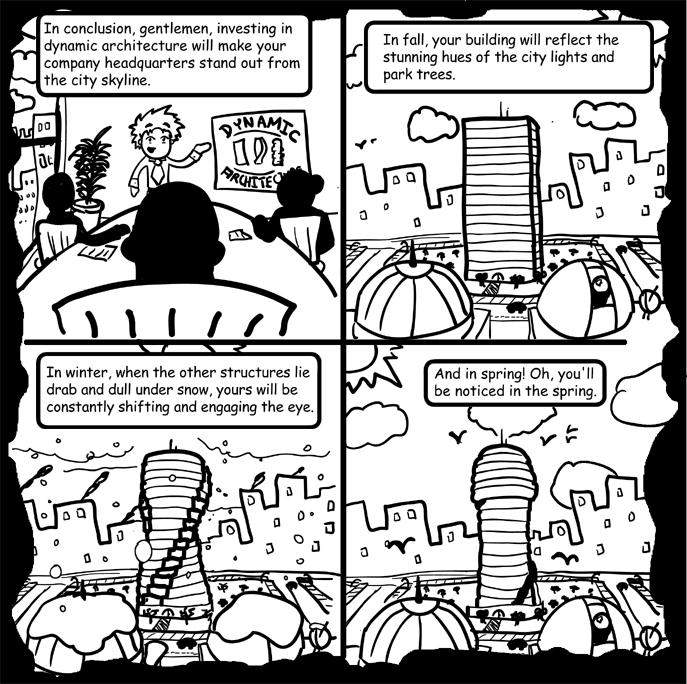
Dynamic Architecture Comic

Here is the new Repiphany! page:


See what I've done here? I've taken the building of the future and turned it into a phallus joke! Mother would be proud.

I am learning that putting a lot of detail into your comic takes a LONG TIME. I've either got to revert to my old, simple format, or just do the drawing over multiple days. This 3-hour comic is not going to fly.
Dynamic architecture is actually an idea, by the way. YouTube the phrase and you'll see what I mean. check out this link, too, very fascinating.
Peace.

Wednesday, May 6, 2009

Enlightenment, Eventually

A new Repiphany! comic:

The full-sized page can be found here.

Sad to say, but this actually happened to me. I bought a ticket to see the Dalai Lama two months ago and marked it on my calendar... Then completely forgot there were 30 days in April instead of 31.

No inner peace for me! But check out this link from a 2007 Dalai Lama lecture that I imagine was much like this year:

I have 2 other comics already sketched up! There should be a shorter break between this update and the next.

Wednesday, April 29, 2009

Sympathy for "Fence Sitters"

I had something of a revelation today.

A question World English Literature final exam today asked me what I thought "should" be done about the humanitarian crisis in Darfur. Attached to the essay was a brief editorial written by John Bolton, former U.S. Ambassador to the United Nations. In it, Bolton argued (correctly, as far as I understand international law) that action through the International Criminal Court is an tremendously poor way to bring Sudanese President Bashir to justice and to save the Darfuris, because such action is outside the scope of it's mandate. Suffice it to say that the I.C.C. does not have to power to indite members who are not signatory to its treaty, and rather than violate international law and state sovereignty, the world should seek to empower the Sudanese themselves to deal with Bashir.

This seemed to me, as I first started writing my response, to be a somewhat callous solution to the problem. Anyone who has heard or seen anything of the brutal, mass killing of the Darfuris in the west of Sudan know that nothing short of full-scale military intervention can prevent the janjeweed - backed by the Sudanese army - from slaughtering every single indigenous African darfuri down to the last burned village. To "respect state sovereignty" in this matter essentially amounts to sacrificing the Darfuris to their fate... another genocide in Africa to hang around the world community's shoulders.

But as I weighed the alternative option of armed intervention, I realized that the alternative that it represented casts shadows equally as dark. Violating international law, even to bring an evil man to justice and save a desperate people, sets a dangerous precedent in international law. Wasn't this how President Bush justified the Iraq war after it had been made clear that there were no weapons of mass destruction to be found? Doesn't the continual disregard for international codes of conduct and state sovereignty weaken and destroy central pillar supporting our world institutions in the first place? If they fail, the undeniable truth is that many more people whom the U.N. protects and helps will also suffer, the Darfuris not the least of all.

It looks as though the crisis in Darfur is one of the "dirty hands" scenarios that my philosophy professor warned me about - one in which those in power must make a decision that invariably lays some sort of moral responsibility at their feet.

Is justice truly justice if adherence to law means that bad men go free and good people die? Is breaking the law justified if the protection granted by the rule of law is dissipated? To say that international law is flawed doesn't do much to help find an answer to the problem. The law has already failed - it must be revised, but that is a question for tomorrow. Today's question must be answered first.

As I wrote in my paper, the daily struggle of a government major is to avoid becoming one of Ayn Rand's hated "Fence Sitters" - people who are unable to make a bad decision and end up paralyzed, unable to make any meaningful choice whatsoever. Seeing all sides of an issue is one thing. Making a decision at the end of the day is quite another. Ultimately we must choose, because apathy is a choice far worse than either alternative. I feel more sympathy for Bush now, and really, for any government figure that is forced to make such a terrible decision. Perhaps that is the fundamental aspect of international relations - Obama certainly says that few decisions that make it to his desk are easy ones.

I penned in my conclusion that, since we must choose, perhaps we choose the answer that seems to help the most people, the soonest. If only to sleep better at night, we should make the choice that allows these poor victims of atrocity to survive the day. I think I might rest easier with my humanity intact, knowing that I had made a decision to help real people, now, in front of me, rather than theoretical people over the next hill.

Tuesday, April 14, 2009

Shrinking Cell Phones and Web-Lectures

First of all, a new Repiphany! page is up. Here is the comic for your viewing pleasure.

As usual, click here for the full-size.

The cool thing is I believe that vocal-chord phones are really on their way. My nanotech course has been worth-while, if only because it's helped me to discover what can be done on the tiniest of tiny scales. The time is not too distant when our phones and music players are literally a part of our bodies. Think of what the social consequences of that would be! Constant connection to the outside world. An end to texting? Never having to buy earbuds again.

It's a scary thought, but hey, it's the next step. The light bulb probably freaked a lot of people out in Edison's time, too.

Speaking of scary thoughts thoughts, check out TED. It's a video lecture website featuring a host of speakers from Richard Dawkins to Anna Deavere Smith. For about 20 minutes each, speakers provide their thoughts on issues from the American character, to believing in crazy things, to UFOs, to the faulty wiring in our brains. So far every talk I've listened to has been engaging, and many of them have been genuinely funny! Thank you to Roman for this treat.

Also, read JFK's Commencement Address and American University on June 10th, 1963. I don't think I've ever read a more eloquent speach advocating for peace.

Best of Luck!

Derek

Wednesday, April 1, 2009

Derek's Epic Audiocast - Episode #01

Because Blogging and Twitter just aren't cutting it in my efforts to get Google searches to pay attention to me, I've decided to create a webcast. In Episode 1 of Derek's Epic Audiocast (cue trumpets) I talk about my attempts to meld two songs together that have each been looping around in my head. After experimenting a bit, I came up with something that I think is halfway decent. Take a listen!


Let me know what you think. The two songs that I mixed are Zero 7's "Simple Things" and Little People's "Above the Clouds."

After this experience, I think it'd be fun to do a podcast with a few friends. Anyone want to form a group to talk about politics for half an hour or so? Drop me a comment.

This is why indie games are cool.


Check out this video. Apparently 3d is breaking into the indie scene as well. It's a simple concept that seems to be a lot of fun.